COFFEE
 TEA
TEA CAPPUCCINO AND HOT CHOCOLATE
 SWEETS
 SYRUPS
 TABLEWARE
 RELATED PRODUCTS
 GIFTS AND SOUVENIRS
Angolan coffee is a long-established export product. Unfortunately, the country faced troubles that hit hard on all sides of life and economy, including the coffee industry. In Angola, during the war period (since 1975), the production of this product, which is in demand on the world market, has decreased by a hundred times. In the decades since the end of the war, the state has not been able to revive the former prosperity of the industry.
Lost positions
Until 1975, Angola boasted excellent results in the coffee industry:
- in the best years, the country ranked third among the countries producing coffee;
- the harvest reached 250 thousand tons;
- half of the export foreign exchange income came from coffee
The reduction of plantations over the difficult years was incredible - from 500 thousand to 50 thousand hectares.
When Portugal abandoned its colonies, it left Angola (as it might seem) a good legacy in the form of a developed agricultural industry. Back in the first half of the 19th century, the Portuguese achieved commercial success by laying the coffee plantations in this country. In the 19th and 20th centuries, excellent robusta grew on hundreds of colonial-owned plantations. The Portuguese settlers owned large lands, and also had factories for processing and roasting grains.
Freedom from Portuguese rule led not to peace, but to civil war. Nationalization was not just a rejection of the former masters. Managers and technicians have left their jobs. Most of the skilled agronomists have emigrated. Farmers have fled their areas as a result of acute internal conflicts.
Previously productive trees have run wild and degenerated. They began to receive 130 kilograms of coffee per hectare (in 1974 this figure was more than 400 kg).
Interest in Angolan coffee
But the desire to revive once lucrative plantations does not disappear. Firstly, this is due to the excellent climatic conditions for coffee trees in Angola. Secondly, with the increasing demand for coffee in many countries. Despite the crisis in the industry, Angolan coffee is still highly valued in Portugal and Spain. Some businesses are willing to buy coffee in order to incorporate it into a blend of different varieties. Wholesalers are annually interested in purchasing local products. In 2019, the country exported 35 thousand bags (60 kg each) of green coffee beans, which is more than 2 thousand tons.
A number of African countries grow either Arabica or Robusta. Angola produces both. However, there is much more robusta, about 90%. Local robusta grows at an altitude of about 1000 meters above sea level. At the same time, tasters note its high quality. In the brewed drink, it has a pleasant mild taste.
A difficult path to rebirth
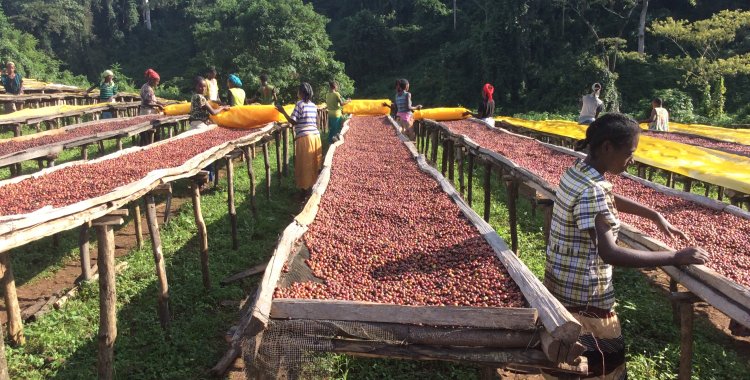
European experts emphasize that it is important for Angolan farmers not only to increase the number of plantings and the total volume of the harvest. Due to hostilities, plantations have been reduced, infrastructure has been destroyed. But what is no less annoying is that the supply chains, trade links and even agronomic skills and knowledge have been lost. The industry is experiencing a "staff shortage": agricultural technology requires the training of new specialists. Even the province of Uige, the historical homeland of Angolan coffee, is in short supply of qualified managers.
Since 2006, the Angolan government and the International Coffee Organization have endeavored to provide plots for the cultivation of coffee trees to thousands of Angolan families. Coffee producers must obtain an appropriate license. Local farmers have small plots - colonial plantations are a thing of the past. The peasants do not have fertilizers and even equipment for cleaning and processing fruits. Moreover, there are no devices for roasting finished grain.
About 25 thousand Angolan families work on their plantings. Improving the quality of the coffee berries they harvest would help them get a decent price for their produce. Although coffee is grown in an environmentally friendly environment and without the use of chemicals, it is not certified organic. Therefore, sales agents try to buy decent quality coffee at fairly low prices.
Many expert studies are not about maintaining the consistent quality of Angolan coffee, but about how to revive the industry. Old trees are not able to bear fruit as before and produce quality grain. It is necessary to rejuvenate the plantings, but there are not enough resources for this. Insufficient care leads to damage to trees by pests and diseases.
Nurseries are of great importance for the reanimation of the sector: new seedlings are being grown by a research station at the National Institute of Coffee. The investments required for the restoration are estimated at a quarter of a billion dollars. There have already been many programs to revive the coffee industry - both subsidies and microcredits for farmers. The modernization of the industry requires a colossal budget, 1 million euros is a drop in the ocean.
They note that government investments have brought results, at least they have begun to pay off. Several international organizations have responded to the plight of coffeefinancial industry in Angola by providing financial support. But the country is still far from the indicators of other African states (Ethiopia, Uganda, Kenya).
Unforgettable taste
Those who, in their travels around the world, have tried high-quality options for a flavored drink, will never forget the bright taste sensations. They can easily distinguish real coffee from a fake one and will tell you about the special nuances of the varieties they tested.
Well-known brands help out every connoisseur of a fragrant cup. Coffee growers help consumers who have never been to a coffee plantation experience Arabica and Robusta grown in Latin America, Asia and Africa. The catalog "Coffeeynya" coffeeynya.ua presents the best modern brands of coffee beans and ground coffee. Espresso, mocha and cappuccino make every day more successful, productive and joyful. Choose, and we will deliver!







-400x300.jpg "Coffee Industry: Cuba")